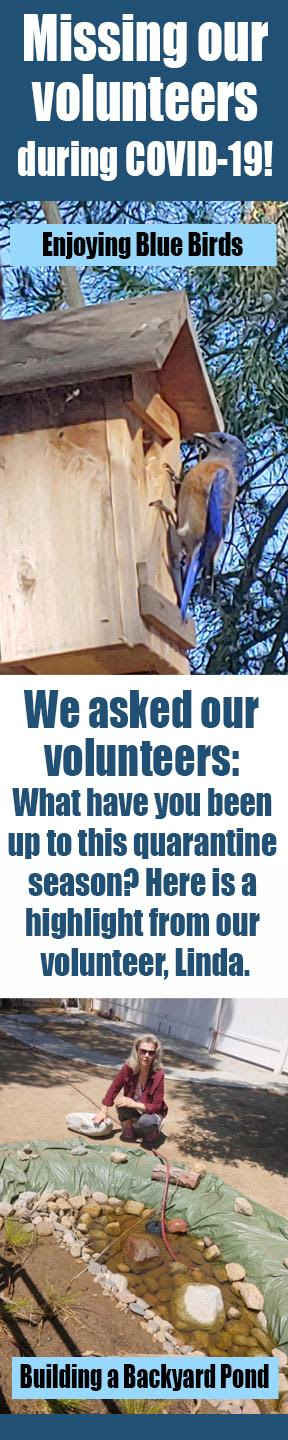






 Yesterday, the cold late November Santa Anas went roaring through my backyard, shredding leaves from the trees and bending their backs to near breaking. Everything seemed in constant motion, a turmoil of branches on the tree rippling and snapping and the air crackling of the sounds of things just trying to hold on. I was astonished to find that it was just an hour later that the maelstrom suddenly turned to stillness. It was almost eerily still. Not a branch or a leaf moving, trunks of the trees now motionless, resting. The air was suddenly filled with birdsong and the crepe myrtle tree came alive with a large cloud of tiny grey bushtits, zapping in and out of the still branches. The resident pair of black phoebes appeared to do their daily dance. I call them tuxedo birds for the black topcoat and fine white bib they sport! One will sit upon the highest point of the feeder pole, suddenly swoop down to catch an insect in the grass, and return to the perch to enjoy his quarry. He will then switch places with his mate, who repeats the dive to the grass and up to a perching lunch. A couple of yellow finches, hanging upside down on the feeder sock to dine on the Nyler seed, look oddly inebriated. I want to ask them all, where di you go when the fury was roaring through just an hour ago? Where is your place of safe harbor where you took refuge? Did you stop your signing because you knew that you wouldn't be heard over the wind's tirade? When do you know it is okay to start singing again?
These are the questions I am asking as I begin to review the tumultuous year of 2020. So many of us have been buffeted by the storm, nearly broken by its seemingly constant motion of conflicting energies and grief. We've felt old allegiances and traditions sorely test, or in some cases shattered beyond recognition. We've been asked by this terrible pandemic to alter the very fabric of our lives, the touchstones which have allowed us to remain human: human closeness, family celebrations, routines which ordered life, cancelled or postponed for fear of health and financial welfare. Where did we go to find safety and when did we know it was alright to step back out into this brave new world? 2021 approaches, I can still barely clear my head enough to see the forest for the trees.
So as I reflect, and 2021 approaches, I'm taking some wisdom from nature. I am contemplating three questions, and you are welcome to join me: Where do I find my refuge? Where have I silenced my own song, and why? When do I know I can sing again? I know these answers may come slowly, but I believe that the raging winds and crackling branches have swept away unnecessary things now to be counted as dross. Storms are like that. The dawn that rises may seem familiar, but it is filled with newness and possibility.